Bibliothèque nationale de France · MS français 3151, f. 71r · Lisbon, December 1558
Breaking a French ambassador's cipher
In December 1558 the French ambassador in Lisbon, Michel de Seure, wrote to the secretary of state de Fresne and put twenty lines of the letter in cipher. We found no decipherment of them beside the letter and none in print. The cipher is now broken in its main lines, from passages that a clerk of the period deciphered, and about half of the passage can be read.
Published 3 October 2026, reviewed and approved by Thomas Leeming. The transcriptions and the French readings were made by AI models, from the library's scans of black-and-white microfilm. No specialist in sixteenth-century French hands has checked them yet; corrections are welcome.
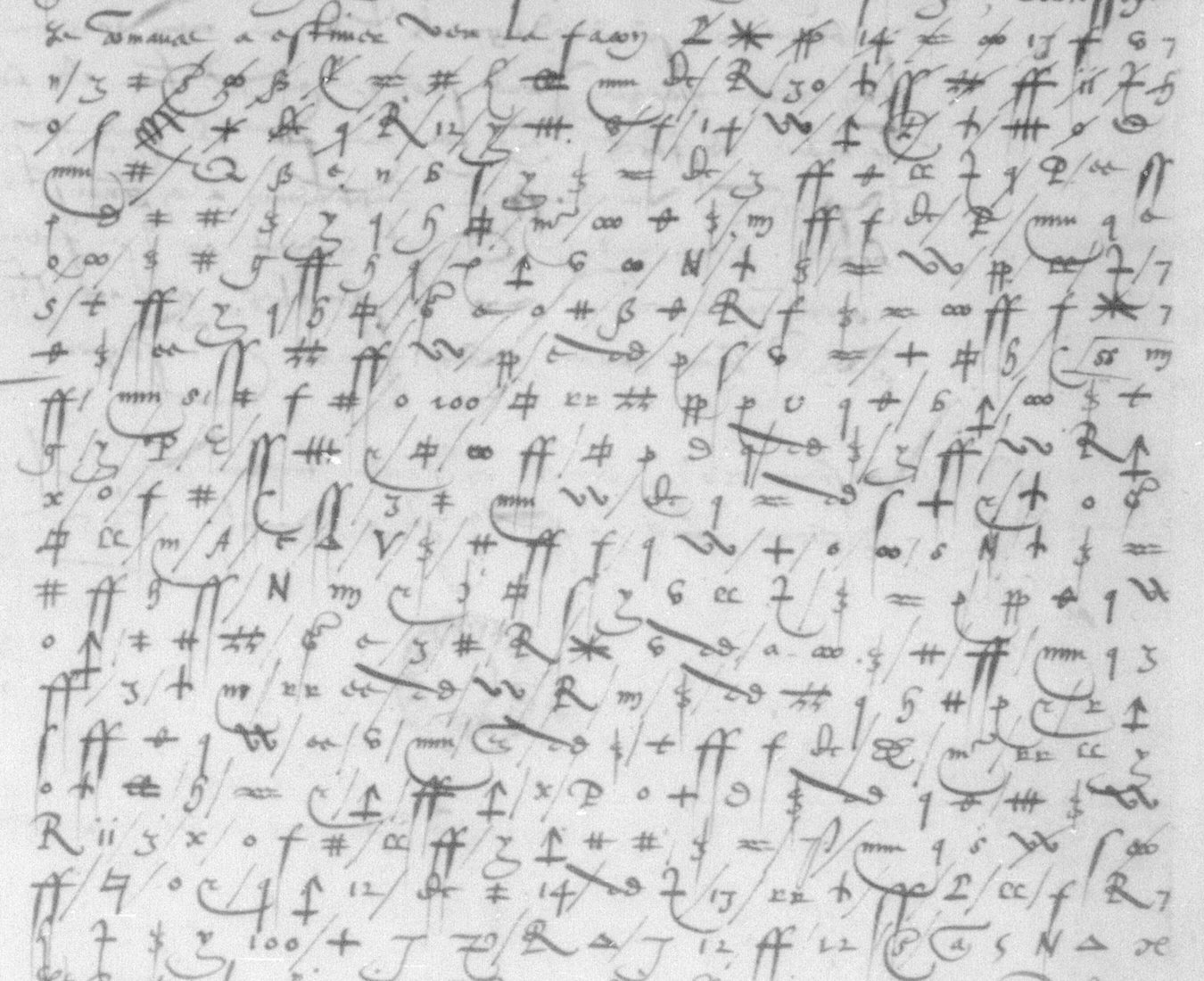
What the letter says
[… I begin to think, given the way] in which our neighbours … [about a line and a half not read; perhaps something about a treaty] … if they say … [a word not read], the matter (?) will turn out otherwise than I had hoped. Whatever comes of it (?), it will be a pleasure to me to hear the outcome, for … [not read] … to draw near the time when … shall have completed these (or: his) two years. We have held the peace here as … made (?). I do not know (?) what will come of it, which made me (?) have still more doubt. I do not wish to stay here much longer, and (?) at worst I want only to finish my two years here. I (?) am in … need, … have had a great deal of … [last line not read] [the clear French goes on: … and press at once for the payment of my salary for this year …]
Words followed by (?) are guesses from sense. Dots and remarks in square brackets mark what is not read. The opening and closing words in square brackets are clear French on the page, not cipher.
The firmest sentence
i e neu / e u cx Pl u s DE m eure ric y [?]u / ieres l o n g ue ment DE au Pis / ale r ny u eu g queache uer mes / DE[?] u g ans
Ie ne ueu[l]x plus demeurer icy [g]uieres longuement … au pis aler n'y ueu[x] que acheuer mes deu[x] ans.
I do not wish to stay here much longer … at worst I want only to finish my two years here.
First row: what the code printed for lines 14 to 18, with / where a line ends, upper case for a weak value and [?] for a sign with no value (the first of them was given four different names by the four readers). Second row: our reading. Letters in square brackets were supplied or changed against the signs. The x of ueux and deux is from sense: the passages with known text give that sign the value g more often than x (14 times to 3 when all five are counted). One sign with no value, inside deux, is passed over.
About seven weeks later, on 30 January 1559, Seure asked the King for a successor, in a letter printed in 1895. This passage shows the same wish already put in cipher to the secretary of state in December. We have not read Seure's other despatches of 1558, so we cannot say it is the first time.
The French
[… Je commance a estimer, veu la facon] dont noz uoysins …ent de … traicte (?) de … [about a line and a half not read] … s'ilz disent … q[ue] la c[h]ose (?) sera autrement que ne l'ay es[p]ere. [Q]uoy (?) qu'il en soit, ce me se[r]a plaisir d'en entendre la resoluci[o]n, car … [com]mence (?) … aproc[h]er du tem[p]s que … aye acheue ses deu[x] ans. Y auons tenu icy la paix pour … [faict]e (?). Ie ne sc[a]y (?) ce qu'il en se[r]a (?), qui m'y [f]aisoit (?) en[c]ores (?) auoir plus de doulte. Ie ne ueu[l]x plus demeurer icy [g]uieres longuement, [et] (?) au pis aler n'y ueu[x] que acheuer mes deu[x] ans. [I]e (?) suis en … necesite, … ay eu tout plain de … [last line not read] [… et poursuivre incontinant l'assignation de mes estatz de ceste annee …]
Spelling as the cipher gives it: u for v, i for j. Square brackets round a letter mean it was supplied or changed against the decoded sign.
The cipher
- It is written in drawn signs: hash shapes, crosses, loops, letter-like forms and a few numbers. Our transcribers used about ninety sign names. How many distinct signs there are is not settled; our two cataloguers estimated between 50 and 80.
- Each common letter has several signs. The letters e, n, o, r, t and u have three or more each. This hides the letter frequencies that would give a simple cipher away.
- A few signs stand for a whole word or syllable: de, que, pour, au, si.
- Numbers such as 12 and 14 mostly stand for nothing. They cluster at the start and end of a passage, as padding.
- There are no spaces between words.
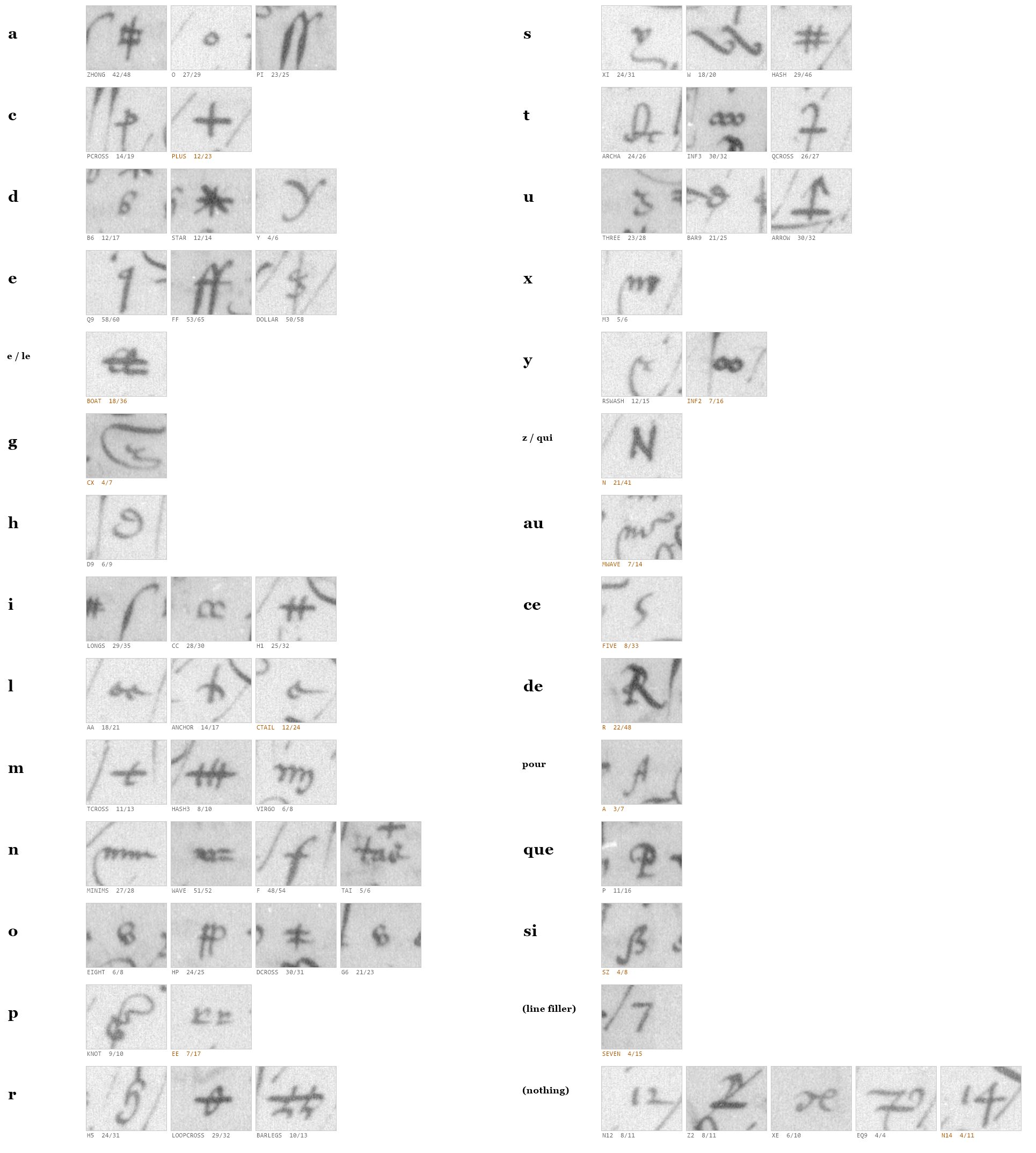
65 sign names have a well-supported value and 9 a weak one, of 94 names used in passages B and C. Well supported means the sign's commonest value, seen at least twice and in at least half of the sign's occurrences. The letter g is the least secure, and b, f and q have no settled sign yet.
How it was broken
- Known text in the same volume. Seure wrote to King Henri II in the same weeks, also partly in cipher. For two of those letters a clerk of the period, presumably where they were received, wrote out the deciphered passages on separate leaves, which are bound in. The clerk marked the cipher passages of one letter A, B and C in the margin and the plaintext paragraphs with the same letters. So the key was recovered from known text, not from the cipher alone.
- Transcription by readers who were not given the key. Each line of cipher and each line of the clerk's French was cut out as an enlarged strip and read by AI readers, who had a list of sign names and were not given the key or any expected text. Passages B and C were read twice, independently; the two readers gave a sign the same name at 88 positions in 100. Passage A and letter no. 40 had one reader per line.
- The key. A fully automatic method worked on made-up data and failed on the real letter. What worked was reading part of passage B by hand, where whole words stood out (sont mal armez de toutes choses, qui partit dicy en octobre), and writing down 37 sign values from it. When the key was later fitted to more text, 32 of the 37 held and five were corrected.
- Tests on text the key had not been built from. Those 37 values, unchanged, were applied to passage C before the letter to de Fresne was decoded. After the first reading, Thomas asked for the key to be firmed up, and the key built from passages B and C, unchanged, was applied to three more deciphered texts: passage A, and letter no. 40 to the King with its postscript. Each time the decoded letters agreed with the clerk's French far better than chance.
- The letter to de Fresne. The key built from passages B and C was applied by code to the passage with no known plaintext, transcribed by four independent readers per line. Nothing was adjusted to make sense.
- Three AI readers of sixteenth-century French then read the decoded letters: two independently and one instructed to attack our reading. They agree on the outline given above. They had been told that Seure asked for a successor in January 1559; the sentence above was already legible in the code's output before they saw it.
All the AI readers were separate runs of the same model, Claude Opus 5.5, given the same images and instructions. They are independent of each other's answers, not of each other's habits. The target passage has four readers because the two-reader job was run a second time by mistake; the second pair was independent, so it was kept.
The held-out tests in numbers
| Passage, and the key applied unchanged | Signs | Decoded letters found, in order, in the clerk's text | Same signs shuffled: best of 200 |
|---|---|---|---|
| C (reader 1), 37 values from B | 386 | 222 of 295 (75%) | 160 (54%) |
| C (reader 2), 37 values from B | 386 | 208 of 287 (72%) | 162 (56%) |
| A, key from B and C | 1,157 | 745 of 1,022 (73%) | 504 (49%) |
| Letter no. 40 to the King, key from B and C | 1,084 | 682 of 906 (75%) | 458 (51%) |
| Its postscript, key from B and C | 352 | 242 of 317 (76%) | 156 (49%) |
The measure is generous: shuffled signs already score about half, and no pass mark was set beforehand. What counts is that the true order beats every one of 200 shuffles by a wide margin each time. The start of the postscript shows the real quality. As decoded:
ieoub?bio?ysa?ssqueimaisadi?s?luatre?g?miees?uzmorciit?amentauroy
The clerk's text:
ioublioysauousdirequelaroynemaryelaissaplusdequatrecensmilescuzenortestamentauroy
What the tests show: the common sign values are right far beyond chance, and all five passages are in one cipher. What they do not show: that any single sign value is right, or that any one reading in the letter to de Fresne is right. That also depends on its own transcription and on the letters we supplied. Limits of the first test: the 37 values were chosen by reading, not by a fixed rule, and passage C had already been used in the automatic attempts that failed. It was first run before one reader's last six lines had come back, with the other reader's lines standing in (77% and 72%, against 55% for shuffles); the rows above are the re-run on the complete transcription. Letter no. 40 is dated 27 December in the library's notice.
With all five deciphered passages counted (3,402 signs), 59 of the 65 well-supported values keep the same commonest value. Of those, 48 are still well supported and 11 became weaker, among them the word-sign for que and signs for c, h and g; the three added passages had one transcriber each, which adds noise. The six that change are blanks or near-blanks, and one sign the French readers had already said stands for si. No reading of the letter to de Fresne changed; three gained support from the signs. The page prints the decode made with the key from passages B and C.
The passage, line by line
407 signs after voting among the four transcribers: 348 on which all agreed, 36 decided by a majority, 23 with no majority. Second column: exactly what the code printed. Lower case is a well-supported value, UPPER CASE a weak one, a name in square brackets a sign with no value, {a|b} a tie between readers, and a space a thin slanting stroke on the page (see below).
All 20 cipher lines
| Line | As decoded by the code | Our reading | Standing |
|---|---|---|---|
| 1 | do A n t [N13] noE | dont no- | probable. Two number signs taken as blanks (the five-passage key confirms both as blanks); the 7 at the line end as a filler. |
| 2 | z uo[CX(S)] Y i y n {s|[HASHB]} IL ent DE e m ar e [II] t rE | -z uoysins …ent de … tr- | probable for 'noz uoysins'; the verb and what follows not read. 'noz voisins' also stands in clear French a few lines above. |
| 3 | a i [MBIG] c t e DE s mi n A s ug l ma {h|[THETA]} | -aicte (?) de … | possible for 'traicte'; the rest of the line not read |
| 4 | ns [THETA] ilz {o|d}i sent serPte [PHI] la | … s'ilz disent … q[ue] la | 's'ilz disent' probable to certain; the word after it not read; 'que' probable. Two transcribers in four read the d of 'disent'; two read a sign meaning o. Readers offer 'uerite' or 'secrete' for the next word; neither is supported by the signs. The five-passage key gives the first sign 'si' and the sign before 'la' q, as the French readers proposed. |
| 5 | coos e se ra au tre ment {[L]|que} nel | c[h]ose sera autrement que ne l' | 'sera autrement que ne l' certain; 'chose' possible. For 'chose', two transcribers in four read the sign for c and one in four the sign for h. Two in four read the sign for 'que'. |
| 6 | a Y es Uere yuoY z {l|c}e ns o {e|P} t E | -ay es[p]ere. [Q]uoy (?) qu'il en soit, | 'ay espere' probable; 'qu'il en soit' probable; 'quoy' possible. The p of 'espere' is a value the sign took in the known passages. In 'qu'il en soit' two transcribers in four read the l and two in four the i. |
| 7 | E me se da pl a {s|i}ir DE nen ten dE | ce me se[r]a plaisir d'en entend- | probable to certain. All four transcribers read the sign in 'se.a' as one that means d; r is supplied from sense. Two in four read the i of 'plaisir'. The five-passage key gives the sign before 'r' in 'plaisir' the value 'si', which settles 'plaisir' whichever way the tie goes. |
| 8 | re lare s o lu c i {h|d|a|IL}n car y[SS]m | -re la resoluci[o]n, car … | 'la resolucion, car' certain as words. Four transcribers gave four different names to the sign for the o. |
| 9 | e nE ins a[N100] aProcder du tem | … [com]mence (?) … aproc[h]er du tem- | 'aprocher du temps' probable; the rest not read |
| 10 | U s que [X_EPSILON] amy a Ye ache ue s e sDEu | -[p]s que … aye acheue ses deu- | probable. The subject of 'aye' is not read. |
| 11 | g a ns ya uons tenuicy lap | -[x] ans. Y auons tenu icy la p- | certain as sense; the x is not supported by the key. The sign read x here has the value g in the key (g 14 times, x 3 times, when all five known passages are counted). We read x from sense in three places: here and in lines 17 and 18. |
| 12 | ai x POUR l i h e ien es c o Y Ezlen | -aix pour … [faict]e (?). Ie ne sc[a]y (?) ce qu'il en | 'paix pour' certain; the rest possible. The clear French above has 'tenoient la paix pour faicte'. |
| 13 | se{o|u}a zmyuai soit enm ores | se[r]a (?), qui m'y [f]aisoit (?) en[c]ores (?) | possible. One transcriber in four read the sign for c in 'encores'. |
| 14 | au oir pl us DEdou lt[DOT]e i e neu | auoir plus de doulte. Ie ne u- | certain |
| 15 | e u cx Pl u s DE m eure ric y {[X_HALFEE]|[X_SINGLE_SMALL_E]|[X_SMALL_SQUARED_R_ON_BASE_ST]|[X_HALF-EE]}u | -eu[l]x plus demeurer icy [g]u- | certain as words. One transcriber in four read the sign for l. The g is a small sign with no value in the key, supplied from 'guieres'. |
| 16 | ieres l o n g ue ment DE au Pis | -ieres longuement, [et] (?) au pis | 'guieres longuement' and 'au pis' certain. The sign before 'au pis' decodes as 'de', which does not fit. |
| 17 | ale r ny u eu g queache uer mes | aler, n'y ueu[x] que acheuer mes | certain as sense; the x is not supported by the key. See line 11 for the x. |
| 18 | DE[II] u g ans {DE|t}e suisen POUR neEs i t | deu[x] ans. [I]e (?) suis en … necesit- | 'deux ans' certain as sense (the x is not supported by the key); 'suis en … necesite' certain. One sign with no value inside 'deux' is passed over. One sign between 'en' and 'necesite' is not read. |
| 19 | e E ay eu toA ut [N13] Pl a[L] i nDEE | -e, … ay eu tout plain de | probable |
| 20 | tes[N100] cU DEi U eyEzi | … | not read. About twenty signs, several of them numbers. |
What is not settled
- Lines 2 to 4: what "our neighbours" are doing, and what "they say". About fifty signs.
- Lines 8 to 10: the words between "car" and "aprocher du temps", and who "shall have completed" the two years.
- Line 20: the end of the passage.
- Single letters: the transcribers named about one sign in ten differently from each other, so any one letter may be wrong.
- Has it been read before? We found no transcription or decipherment in print or online, in about a day of searching. Four works were not available to us. J. V. Serrão's four-page article of 1969 in Arquivos do Centro Cultural Português is reported to print some of Seure's despatches of late 1558 from this same manuscript, and it is not online. Two other works on the embassy, Matos (1952) and Chichkine (2021), could not be opened, and Potter (2014) was seen only in preview.
- The rest of the volume. We looked at the openings around these letters (Gallica views 70 to 88) and found no decipherment of this passage there; the library's notice mentions none. We did not examine the rest of the volume. A letter to the King of the same month, almost wholly in cipher (ff. 80r to 82r), has no plaintext on its pages and has not been transcribed.
- The strokes. Thin slanting strokes cross the cipher on this page every one to three signs. They may be a later reader's divisions. We cannot date them, and one of our readers took them for show-through from the other side of the leaf.
Credit, and what this does not claim
- Bibliothèque nationale de France holds the manuscript; the images are from Gallica (ark:/12148/btv1b9059865k). Source gallica.bnf.fr / BnF.
- D. Bourdeau's catalogue of unsolved historical ciphers listed these letters as open and untranscribed, which is how we found them.
- E. Falgairolle printed Seure's letters of 1559 in 1895; they supplied the check on the sense.
- Thomas Leeming set the aim of reading messages no one had read, stopped an earlier line of work when it drifted from that aim, chose these letters from a shortlist that Claude put forward, decided what could be downloaded and kept, directed the push to a readable result and the further work to firm up the key, reviewed the work and approved publication.
- Claude Opus 5.5 (Anthropic) did the searching, the image preparation, the transcription runs, the code, the key recovery, the readings and the drafting, under that direction. Every step, including the methods that failed, is recorded in a lab notebook.
- Not claimed: a finished edition. The reading needs a palaeographer who knows French diplomatic hands of the 1550s, a second look at every doubtful sign on the original, and the key tested on the remaining cipher passages of the volume.